Free · No sign-up · Dungeons, battlemaps & realms

Fantasy City Map Generator — D&D towns, villages & cities with districts

Villages, market towns and capitals with districts, landmarks and the people who run them.

Map art

Grid overlay

Locations

Hazards

Map name (optional — leave it blank and we name it)

Describe it

Try

Grid

Scale

Map art, grid and lore in about a minute.

What is the Fantasy City Map Generator?

This free city map generator draws a fantasy city, town or village for D&D. Describe the settlement — a fishing village, a walled market town, a capital on a river — and in about a minute you get a top-down map, named districts and landmarks with a line on each, hazards and trouble, and the history of the place. Free to use without an account.

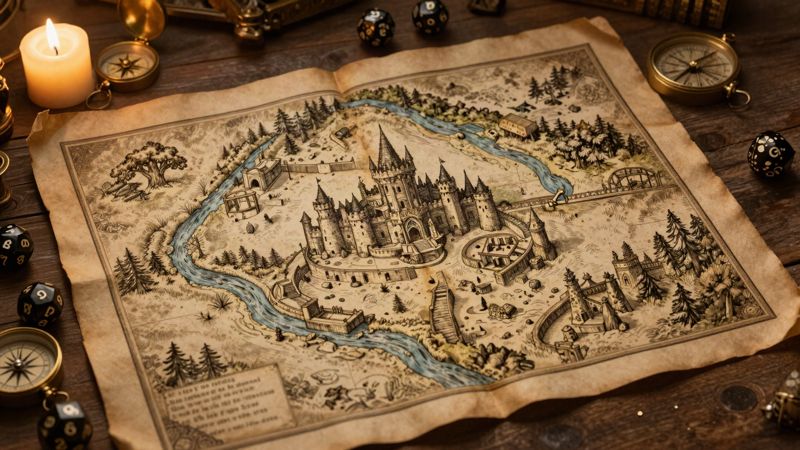
Example map: Saltmarket

What comes with the art: a key of named locations, hazards you can run and the history of the place.

Saltmarket

City · No grid

A tidal river port of about 4,000 people, built on stilts where the river meets the sea, where the salt guild and the smugglers have been at war for a generation.

Map key

  1. 1.The Weighhouse

    Salt guild headquarters and customs house. Every barrel landed in Saltmarket is weighed and taxed here — officially.

  2. 2.Stiltside

    The poor quarter, built on rotting piles over the mudflats. Rope bridges, no streets, and the smugglers’ best routes.

  3. 3.Gull Market

    Open-air fish and salt market at the river mouth. Busy at dawn, empty and dangerous by dusk.

  4. 4.Chapel of the Tide

    Temple to the sea goddess. The bell tolls at high tide, and smugglers time their runs to it.

  5. 5.Harbourmaster’s Tower

    Watch post and lighthouse. The harbourmaster is paid by both sides.

Hazards

  • Tides: twice a day the mudflats flood; anyone on them at high tide must swim.
  • Stiltside bridges: a running chase across them calls for DC 12 Dexterity (Acrobatics) checks.

History

Saltmarket grew from a single salt-pan into a port when the old harbour silted up. The salt guild built the Weighhouse to control it; the smugglers built Stiltside to avoid it.
Fantasy City Map tips

A town map is a menu for the players: every labelled building is somewhere they might go. Name the town’s trade and its trouble — “a river port where the smugglers run the watch” — and the generator puts both on the map.

Cities work best as districts. Each district gets a character, a landmark and a faction, so you can run a sprawling city one neighbourhood at a time.

Pair the map with the free NPC generator for the people: a tavern keeper, a guard sergeant and a noble cover most of what a party will ask about.

Fill it with monsters

The free monster generator makes the creatures that live there, with 5e stat blocks at the CR your party needs.

Open the monster generator

Frequently Asked Questions

Can I generate a village or small town?

Yes. Describe the size — hamlet, village, town or city — and the generator scales the map and the number of landmarks to match.

Does the city map label districts and buildings?

Every map comes with a key of named locations with a short description of each, so you know what every district or landmark is for.

How many people live in a fantasy town?

As a rough guide, a hamlet is under 100 people, a village a few hundred, a town 1,000 to 6,000 and a city anything above that. Medieval capitals rarely went far beyond 50,000.

Can I populate the town with NPCs?

Use the free NPC generator for a tavern keeper, guard and noble, and with a free account pin them to the map where the party will find them.

Is the city map generator free?

Yes. No account is needed, within a small daily allowance. A free account lets you keep generating and save maps.

Get weekly GM tips and generator updates

Join the LoreKeeper newsletter. No spam, unsubscribe anytime.