Free · No sign-up · Dungeons, battlemaps & realms

D&D Battlemap Generator — Encounter maps with a 5 ft grid

One fight, one map: cover, terrain and hazards on a grid you can play on.

Map art

Grid overlay

Locations

Hazards

Map name (optional — leave it blank and we name it)

Describe it

Try

Grid

Scale

Map art, grid and lore in about a minute.

What is the D&D Battlemap Generator?

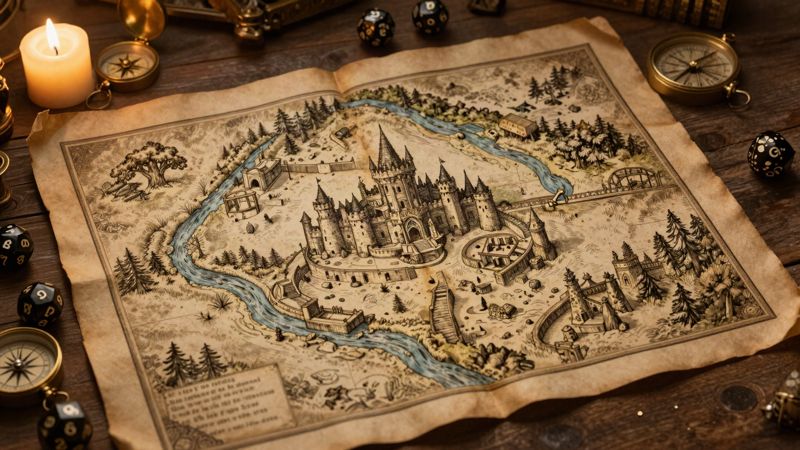
This free battlemap generator draws a top-down D&D battle map for a single encounter. Describe the scene — a bridge ambush, a temple courtyard, a ship’s deck — and in about a minute you get map art on a 5-foot square or hex grid, named features with cover and terrain, hazards, and the story of the place. Download it for Roll20, Foundry VTT, Owlbear Rodeo or print. No account needed.

Example map: Gallows Bridge

What comes with the art: a key of named locations, hazards you can run and the history of the place.

Gallows Bridge

Battlemap · Square grid, 5 ft per square, 24 × 18 squares

A rope-and-plank bridge across a 60-foot gorge, with a ruined toll-house on the near side and a tangle of pines on the far side where bandits wait.

Map key

  1. A.Toll-House Ruin

    Half-cover behind broken walls; the roof is gone. A rusted bell can be rung to signal the far side.

  2. B.The Bridge

    5 feet wide, 80 feet long. Difficult terrain in high wind. A creature shoved off the edge falls 60 feet into the river.

  3. C.Anchor Posts

    Two posts on each side hold the ropes (AC 15, 20 hit points). Cutting both on one side drops the bridge.

  4. D.Pine Tangle

    Three-quarters cover for archers; lightly obscured. The bandit captain waits here.

Hazards

  • High wind: at the start of each round, roll a d6; on a 1, everyone on the bridge must succeed on a DC 12 Dexterity saving throw or fall prone.
  • Rotten planks: the first time a creature moves onto a marked plank, it must succeed on a DC 13 Dexterity saving throw or fall through.

History

The bridge was the only crossing on the old salt road until the toll-keepers were hanged from it for skimming, which is how it got its name.
D&D Battlemap tips

A battlemap is for one fight, so it should give that fight choices: cover to hide behind, high ground to take, difficult terrain to avoid and something dangerous to push enemies into.

Describe the encounter rather than just the place — “a rope bridge over a gorge where bandits ambush a caravan” — and the generator builds the features that make the fight tactical.

Most combat maps are 20 to 30 squares across at 5 feet per square, which is 100 to 150 feet: enough room for ranged characters to matter without making melee characters walk for three rounds.

Fill it with monsters

The free monster generator makes the creatures that live there, with 5e stat blocks at the CR your party needs.

Open the monster generator

Frequently Asked Questions

How big should a D&D battlemap be?

Most encounter maps are 20 to 30 squares across at 5 feet per square. Bigger maps suit ranged fights and chases; smaller ones suit close-quarters brawls.

What scale is a 5e battlemap?

One square is 5 feet in the 5e rules, so a creature with 30 feet of speed moves six squares. The generator defaults to that scale.

Can I use a hex grid?

Yes. Pick Hex grid before you forge. Hexes are popular for outdoor fights because diagonal movement is the same as straight movement.

What makes a good battlemap?

Cover, elevation, difficult terrain and at least one hazard. Every feature should give someone a reason to move.

Can I download the battlemap for my VTT?

Yes. Download the image and import it into Roll20, Foundry VTT, Owlbear Rodeo or Fantasy Grounds, then align the grid.

Get weekly GM tips and generator updates

Join the LoreKeeper newsletter. No spam, unsubscribe anytime.